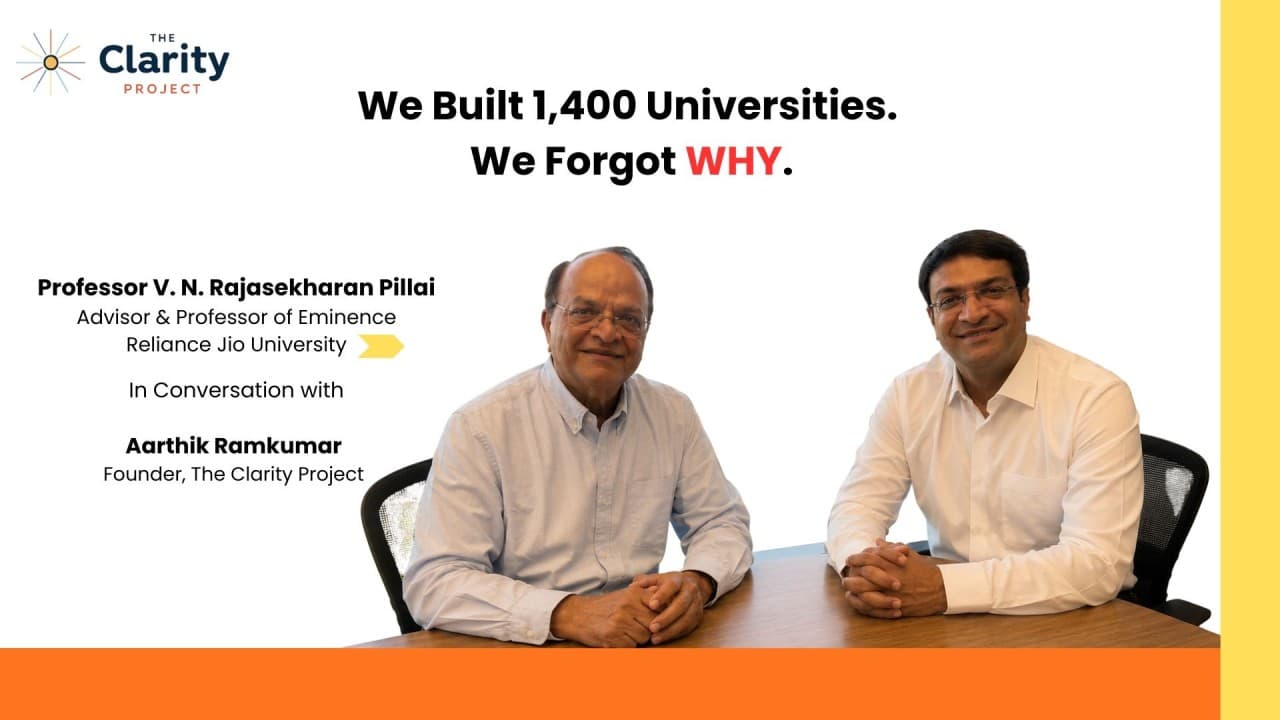
We Built 1,400 Universities. We Forgot Why.
Fifty-five years across every kind of Indian university there is — on infrastructure, freedom, and what actually makes an institution great.
Last year, I went to Somaiya Vidyavihar University to personally invite Prof. V.N. Rajasekharan Pillai, then Vice-Chancellor, to be Chief Guest at the Padma Vibhushan Dr. Rajagopala Chidambaram Memorial Honour, an occasion close to my heart.
The moment I mentioned Dr. Chidambaram's name, he paused. He looked up and said he had known Dr. Chidambaram personally, then agreed to be Chief Guest. No deliberation. No back and forth. Just a nod, and a few words that carried enormous weight.
He was not a man who said much. But what he said made me want to know everything.
Ex-Chairman and Vice-Chairman of the University Grants Commission. Ex-Director of the National Assessment and Accreditation Council. Ex-Vice-Chancellor of central, state, public, and private universities. Teacher, researcher, institution builder, policy expert — an accomplished scientist for the last 55 years, currently Advisor and Professor of Eminence at Jio Institute. Every kind of institution this country has, he has led.
The question that would not leave me alone: what does a man who has done all of this actually believe makes an institution great?
Infrastructure is a facilitator. People are the destination.
Ask VNR how he decides between funding a world-class campus and funding world-class people, and he does not hesitate: build infrastructure around talent, never build infrastructure in the hope that talent will magically appear. Exceptional minds have reshaped history from modest attics. Buildings have never done that on their own.
His capital-allocation order is blunt. Human capital first — endowed chairs, competitive global salaries, doctoral fellowships, seed funds for young researchers get the lion's share of strategic funding. Functional infrastructure second — instrument labs, compute power, collaborative space that removes friction for the people already there. And resist what he calls the "Edifice Complex" entirely: grand administrative buildings and marble foyers add zero value to intellectual output. Every rupee spent on physical luxury, in his framing, is a missed opportunity to recruit a brilliant scholar.
From compliance to creation
VNR draws a hard line between a merely good university and a transformational one, and it isn't prestige or budget. A good university runs on transactional efficiency — syllabus completion, attendance thresholds, exam logistics, accreditation checklists. Its scoreboard is pass percentages and placement statistics.
A transformational university runs on intellectual urgency and psychological safety instead. The hallway conversation shifts from "what's on the exam?" to "what problem are we solving?" Students build startups and challenge paradigms instead of rehearsing for interviews. High-risk research failure is treated as a badge of honour, not a black mark — because an institution that only ever succeeds is an institution that never tried anything difficult.
The same discipline applies to how it prevents becoming a "degree factory": curriculum built around inquiry instead of lectures, tenure decisions that reward original thinking over teaching hours logged, and assessment built on thesis defence and real demonstrations of problem-solving rather than standardised, high-stakes testing.
The leader as lightning rod
On academic freedom, VNR is unambiguous about where the leader stands: absorbing the shockwaves so the faculty can keep seeking truth without flinching. In practice that means independent academic senates and peer-review committees kept structurally out of reach of donors, corporate sponsors, or political lobbies; a diversified funding base wide enough that no single partner can hold the institution hostage; and a leader willing to publicly defend unconstrained inquiry when the research gets uncomfortable.
Surrendering that freedom for short-term political peace, he says, degrades the institution's integrity permanently — there is no getting it back cheaply once it's gone.
Architect, then custodian
Every leader, in VNR's view, moves through two distinct phases, and confusing them is how institutions stall. The Architect phase belongs to a greenfield institution or one mid-turnaround: the leader personally sets standards, recruits the founding talent, and builds the governance frameworks and cultural baseline from scratch.
The signal to shift to Custodian arrives when the system starts running itself — when department chairs hire exceptional people without needing the leader's sign-off, when cross-disciplinary research starts happening spontaneously, when the community defends the institution's values without being told to. Miss that signal and bold pioneering curdles into micromanagement. The job past that point is safeguarding what was built, not continuing to personally architect it.
“Infrastructure is a facilitator, but people are the destination. Exceptional intellects in modest attics have fundamentally reshaped human history.”
— Prof. V.N. Rajasekharan Pillai
Building what outlasts you
True institutional greatness, VNR argues, is measured by sustainability, not charisma — and the mechanism is almost administrative in how unglamorous it is. Institutionalise, don't personalise: if a policy only works because of one specific leader's personality, it was never a policy, it was a dependency. Cultivate a real second line by giving deans and department heads actual decision-making authority, not just titles. And protect the hiring bar without exception — an institution that keeps hiring people brighter than its current faculty keeps its trajectory pointed upward regardless of who eventually sits in the leader's chair.
What actually proves greatness
Pressed on the single metric that would prove, fifty years from now, that an institution achieved real greatness, VNR doesn't reach for rankings or endowment size. It's lineage: how many ideas, breakthroughs, and leaders originated inside those walls and went on to alter the trajectory of human civilisation or national life. If major challenges a half-century from now trace back to a solution first framed at your institution, that is the only proof that counts.
It reframes history the same way — not as an achievement to rest on but as a standard to keep matching. The useful question for any institution to ask itself: would our founders be proud of our current rate of innovation, or would they see us as cautious custodians coasting on their work?
“A leader must act as a lightning rod and an institutional shield. The faculty's job is to seek truth; the leader's job is to absorb the external shockwaves that truth occasionally generates.”
— Prof. V.N. Rajasekharan Pillai
What AI changes, and what it can't touch
VNR splits the university experience cleanly into what must adapt and what must not. Rote information delivery is obsolete — AI already does it better and faster, and clinging to lectures built around fact transmission is fighting a battle already lost. Assessment has to move with it: oral defence, real-time problem-solving, and critical evaluation of AI-generated output, in place of take-home essays AI can produce in seconds.
What doesn't move: Socratic mentorship, the direct human-to-human connection between a teacher and a student. Ethical formation and character, which no model can instil. And the spontaneous intellectual community that only happens when minds are physically in a room together, debating. Technology that deepens research capability and expands what's possible to inquire into is transformative, in his framing; technology that merely repackages the same content into a shinier format is a fad — however good the demo looks.
The 100-day playbook
Asked for a three-step playbook he'd hand any incoming university leader for their first hundred days, VNR doesn't reach for anything exotic: reclaim time, translate research, align with industry.
Strip out the administrative overhead eating 30 to 50 percent of faculty hours — manual grading, procurement paperwork, invigilation, compliance reporting — and hand it to modern workflows and professional support staff, so that time goes back to research and mentorship instead. Shift internal appraisal away from hours logged in a classroom toward tangible output: co-authored publications, invention disclosures, industry-sponsored projects. Then build a small, business-minded internal team whose only job is scouting lab discoveries, matching them to real industry problems, and pushing them toward patents and licensing.
Free the faculty's bandwidth, translate what they discover into something the world can use, and train students directly against real industry challenges — and a university stops being a passive degree factory. That, in VNR's telling, is the whole difference between building 1,400 universities and building even one that matters the way he means it.