India wants to build 50 world-class universities by 2047. He built one, with NO MONEY, NO RANKING AND NO DEADLINE.
The institution that taught India to build industry.
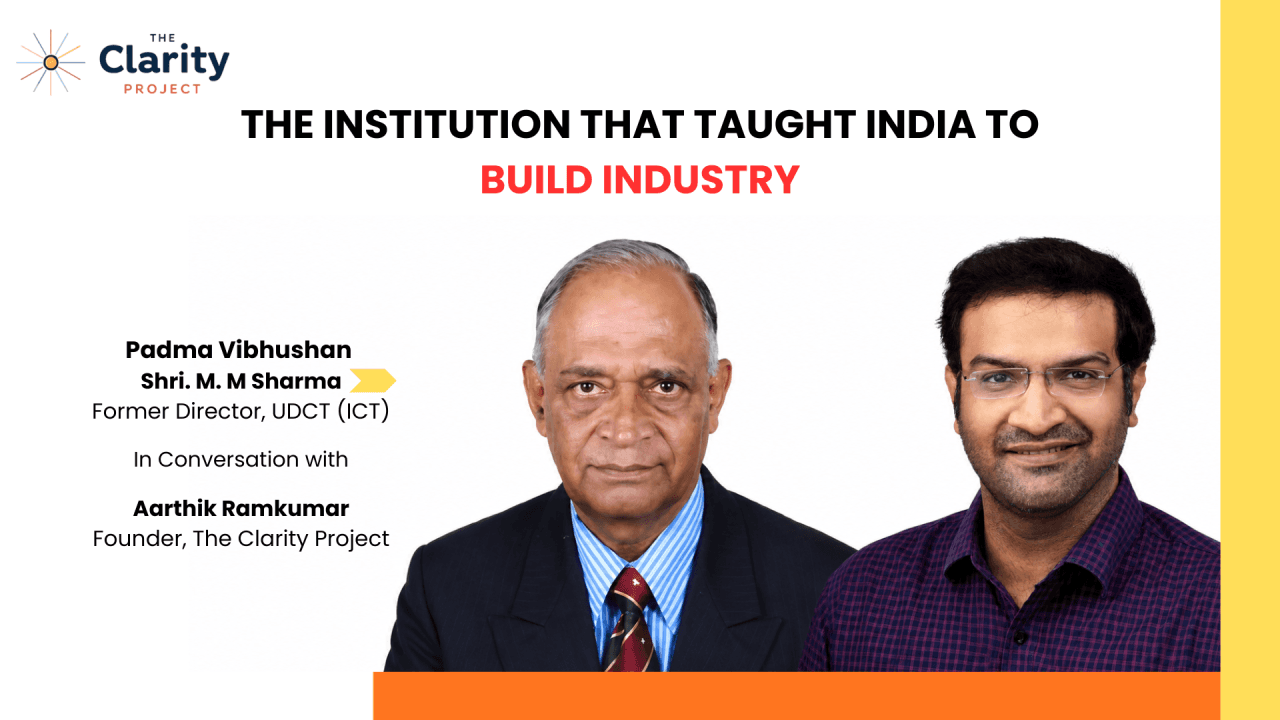
Institution Building
Prof. M.M. Sharma
Padma Vibhushan, Former Director, UDCT (now ICT) Mumbai
I sat down with Professor M.M. Sharma, the man who ran UDCT in Mumbai, the place that basically gave India its chemical industry. I walked in with my questions ready. I walked out re-thinking all of them.
The puzzle
Every state is chasing the same thing: bigger campuses, better rankings, buildings that look good in a brochure. The national goal is louder still, 50 world-class universities by 2047.
So here's a man worth hearing out. Professor M.M. Sharma ran the University Department of Chemical Technology (now Institute Of Chemical Technology) in Mumbai. It's the place, in his words, that gave birth to India's chemical industry. Today it's the Institute of Chemical Technology, a deemed university. He retired as its director in 1997.
He made it world-class without IIT-level money, without a famous name, and without a single ranking to aim for. For years, his university didn't even have a budget line called "research."
Ask him how, and he never once mentions money. He talks about three things: culture, ideas, and the people you leave behind.
Where it came from
UDCT started in 1933 as a department of Bombay University. From day one, it was funded by industrialists, not the government. And it was built to solve a real problem: India's mills could only spin and weave cloth. The country wanted to dye, print and finish it too. That one need pulled a whole chemical industry into being, caustic soda, chlorine, acids, dyes.
Because every course was a postgraduate course, research wasn't an add-on. It was there from the start. The first Indian director, Professor K. Venkataraman, made the place famous around the world with his books on synthetic dyes.
The point Prof. Sharma keeps coming back to: a science institution earns its name by keeping one foot in industry, without ever lowering the bar on teaching or research.
The formula
This is the part most people get wrong. They make a teacher pick one job, teach, or research, or consult. Prof. Sharma refused to let them choose.
At UDCT, every faculty member did four things, in this order:
1. Teach — this always came first.
2. Research — published in the best journals in the world, not just any journal.
3. Write — proper books, not only papers.
4. Work with industry — so the knowledge stayed real.
A teacher who only published was incomplete. So was one who only consulted. Doing all four together was the real strength.
The trust move
Here's the move worth copying.
When UDCT hired a new teacher, the institute went to industry and put its own name on the line: take this person, on our word, for two years. If they didn't perform after that, the institute said it plainly, that's on them. We did our part.
It worked because the results backed it up. One batch did well, so industry trusted the next batch before they'd even arrived.
Prof. Sharma did the same for students. Summer training in industry was always part of the course. He pushed it further and convinced companies to pay students a small amount, a big change in thinking back then. His reasons were simple and human: a student who gets paid feels he has to deliver real ideas, and many of his best students were poor and couldn't afford a placement outside Mumbai otherwise.
8 weeks of industry training in the second-to-last year — built in from day one, never a formality. Two years the runway that industry gave a new hire, on the institute's word. A small stipend that turned an intern into someone who felt he had to deliver.
Culture over money
For decades, UDCT had almost no money. Until the late 1970s, India's rules were so tight the institute couldn't import a $10 part without permission. The university had no budget line for research at all. Funding only got better when the University Grants Commission, CSIR India and Department of Science & Technology started supporting it in the late '70s and '80s.
So what carried it through? Ideas, and a simple habit of hard work.
His PhD students rarely worked less than 70–75 hours a week, not because a rule said so, but because the place ran on the joy of original work. Copying old research is easy, he says. New research needs sharp ideas first, and equipment second.
“You don't create world-class universities with money. You create it with culture.”
— Professor M.M. Sharma
The autonomy turn
The biggest change came in the early 1980s, when Bombay University gave UDCT the freedom to run itself. Now it could change its own syllabus and take donations directly, in ten minutes, instead of a month of paperwork.
It grew from there. The timing matched the institute's Golden Jubilee in 1983–84, and donations came in fast. A new rule then let a university department become independent on its own, UDCT was the only one in the whole country to do it, before becoming a deemed university. Forty staff homes and entire hostels were later built purely from donations it was now free to accept.
But Prof. Sharma is blunt about the trap: most institutions want this freedom but aren't ready for what it demands. You earn it by already being good, and it only works if you keep delivering. Freedom without performance is just a quicker way to fail.
The part nobody plans for: successors
Plenty of institutions are good once. Very few stay good. Prof. Sharma's reason is one line.
Years after he retired in 1997, people told him ICT was still doing brilliantly. His answer: that's not luck, it's by design. The real value of an institution, its standards, its values, the reasons behind every decision, lives in people. Build the next layer while you can still train them, or watch it walk out the door.
“A leader should be known by his successors. From day one, I said I will build successors better than me.”
— Professor M.M. Sharma
The 2047 mirror
On the goal of 50 world-class universities, Prof. Sharma doesn't hold back, and this audience should sit with it.
You can't build world-class, he says. You build a world-class culture, and that needs freedom: freedom from rigid rules, freedom to invest donations sensibly — Indian institutions still can't even keep a donation in a private bank — and freedom to fund real basic research. He points to the giant endowments at Stanford, MIT and Harvard. He points to a Chinese president, a chemical engineer himself, saying out loud that the country must invent, not import. He wants to hear that line from India's leaders too.
He's just as honest about what's broken: a system so rigid you can't remove a teacher who inspires nobody. And the old 80/20 rule, which he says holds true even at Harvard and MIT — about 20% of the faculty do 80% of the work, and an institution is always known by its top performers.
His proudest point: IIT is still the only Indian brand the world recognises. And it was built on a culture of research, not a marketing budget.
The Sharma framework
Seven rules for any university or college that wants to last and lead:
1. Make people do all four, from day one. Every faculty member should teach, research, write, and work with industry. The moment you let them pick just one, you're building a department, not an institution.
2. Back your people, then make them prove it. Put new faculty in front of industry on your word. Give them a real runway. Then be honest that the result is on them.
3. Build successors better than you. Judge yourself by who can run the place after you leave. If the answer isn't a name, it's a plan you haven't made yet.
4. Build a culture of work, not a book of rules. Let students vote for the best teacher, not a committee. Make good work visible, so the person who doesn't work feels left out, without a single memo.
5. Earn your freedom, then use it. Move fast on syllabus, take donations directly, build real ties with industry. But freedom comes after you've proven yourself — never before.
6. Pick the leader carefully, and give them time. The person at the top decides everything. A weak leader never tolerates strong people. Three-year terms are too short to fix anything. Give a leader five years, renew once if they're good, and stop there.
7. Choose culture over money. Ideas first. Equipment second. Freedom always. You can put up a building in three years. You can't buy ten years of a research culture.
One question worth sitting with: Walk into your institution at 6 PM this week and look up. How many lights are still on? Now open your last budget. How much went to the building, and was there even one line for research, or for the careers of the people who do it? Sharma built world-class with almost no money. So what's your excuse?
Based on a conversation with Professor M.M. Sharma — Padma-honoured chemical engineer, former Director of UDCT (now ICT) Mumbai, and one of the few people who actually built what most institutions are still only trying to buy.
Share this conversation
Free Newsletter
Don’t miss the next conversation.
Every week, one remarkable person changing the landscape of education, policy, or enterprise in India. A detailed newsletter with key ideas and frameworks — free, always.
Free forever · Unsubscribe anytime