Indian schools build great followers. Then call them leaders.
The kid with the loudest voice and the best marks isn't the leader. She's spent 40 years proving it's almost always someone else.
Leadership Development
Mrs. Kalyani Patnaik
Principal, Hiranandani Foundation School; Author, The Path to Leadership
I have a confession. For the past couple of years, visiting schools across India, I played a quiet game with myself: walk into a classroom, scan the room, and ask who here is being built into a leader. The answer was always the same kid — loudest voice, best marks, most visible badge on the blazer. I assumed the adults in the room knew something I didn't. That centuries of schooling had figured this out before I arrived.
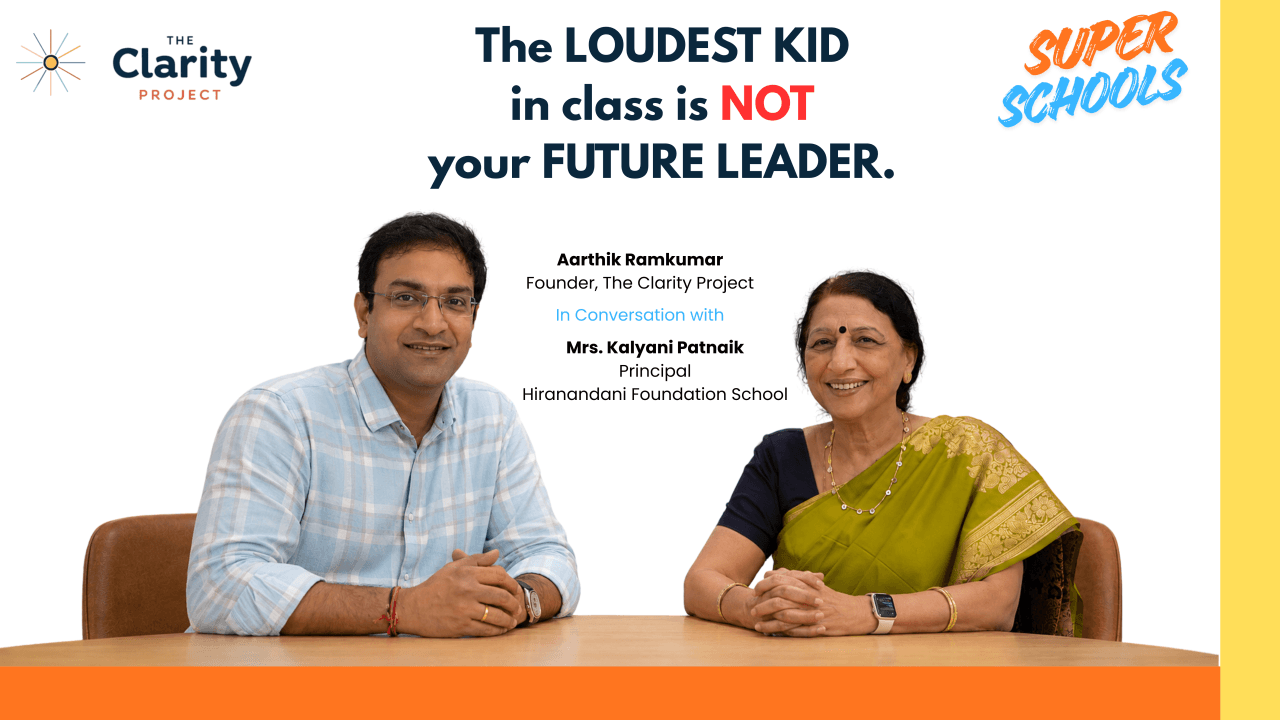
Then I sat with Mrs. Kalyani Patnaik, Principal of Hiranandani Foundation School, Mumbai, and author of The Path to Leadership — forty years in classrooms, the kind of educator who still personally knows every difficult student in her school by name. She said one sentence that reordered everything I thought I understood: "The loudest kid in class isn't the leader. The loudest kid is often the most scolded." Simple. Devastating. True. We've been selecting the wrong children, celebrating the wrong qualities, building the wrong culture — and calling it education.
The biggest leadership lie schools tell
Walk into any Indian school and point to "the leader." Nine times out of ten you're pointing to the kid who raised their hand first, spoke the loudest, got the best marks. That's not leadership — that's performance. Real leadership, the kind Mrs. Patnaik has spent forty years observing, looks completely different: the quiet kid who spoke up for a classmate when no one else would; the "obnoxious" Model UN student who, with the right mentorship, channelled his interruptions into the sharpest argument in the room; the child who laughed when he scored 32 marks, because he found joy in the attempt. That's the kid worth watching.
The one quality schools almost never teach
Mrs. Patnaik has written about eleven leadership attributes. Asked which one Indian schools talk about least, her answer was immediate: imagination. Not creativity, not innovation — imagination, the capacity to think before the world tells you what to think. "We feel we have already imagined for you," she said. "There is no time left for you to imagine." That's the diagnosis. Indian schooling, with its large classrooms, standardised tests, and syllabus pressure, has systematically removed the space where imagination lives. Without imagination, you don't get leaders — you get very efficient followers.
The LEAD framework: look for the right signals
Most conversations stop at the insight. Mrs. Patnaik has a repeatable system instead — L.E.A.D., structured so any school leader can begin next Monday. L is for looking for the right signals: stop selecting leaders by marks and volume. The child worth watching asks a question nobody thought to ask, defends a classmate unprompted, fails and tries again without being told to. In practice: have every teacher name one student per term showing an unexpected leadership quality, and put specific observations on report cards — "Rahul organised the class cleanup without being asked," not "Rahul is a good student."
“The loudest kid in class isn't the leader. The loudest kid is often the most scolded.”
— Mrs. Kalyani Patnaik
Explore, assign, and design the parent partnership
E is for exploring beyond the curriculum — her 4E philosophy (Explore, Experience, Enjoy, Educate) treats the syllabus as a floor, not a ceiling, with one weekly period of open, student-led exploration and no fixed objective. A is for assigning roles that stretch rather than reward: put the disruptive child in charge of managing disruption, give the shy student one public moment a week, ask the loudest student to listen and the quietest to lead. Every role should come with a written reason — "this role will stretch them in this specific way" — not just "they were the best candidate."
D is for designing the parent partnership, because schools can't build leaders from 8am to 3pm and send them home to have it undone. "What is learned is unlearned," she said. Most schools treat parents as an audience; the ones that work treat them as co-builders — a termly workshop on leadership behaviours at home, a monthly "teach your parent" task that inverts the usual dynamic, one specific leadership observation shared per child at every PTA.
The compounding principle
"Every day, try to work only two percent more than what you were yesterday," she said. "By the end of the year, look at what you have accumulated." A teacher who stretches one student per term compounds into a culture over a decade. A school that runs this framework, imperfectly but consistently, compounds into an institution that produces leaders, not just toppers. We apply compounding to finance, to product growth, to habits — almost never to character. It works just as precisely there.
“A leader is alone. Always. The bouquets are shared by all, but the brickbats are only given to the leader.”
— Mrs. Kalyani Patnaik
The moment that defines every leader
Asked for a story from her forty years, she paused, then said: "A leader is alone. Always. The bouquets are shared by all, but the brickbats are only given to the leader." She's lived it — a crisis she won't name, a room where everyone protected themselves and she was left standing alone. What got her through: reading, philosophy, sharing the burden with one trusted person, and the stubborn belief that this too shall pass. That's not a soft answer. It's hard-won wisdom from forty years at the front of Indian education — and it happens to be exactly what should be taught to children not just in the IB schools of Bandra and Juhu, but in the BMC schools of Dharavi and Kurla. Those children deserve the same shot at leadership. Right now, they're not getting it.
The best schools in India don't just build exam toppers. They build people who can walk into a room alone, solve a problem nobody else will touch, and come back the next day ready to do it again. The LEAD framework is how you start building toward that standard — not perfectly, not all at once. Two percent at a time.
Share this conversation
Free Newsletter
Don’t miss the next conversation.
Every week, one remarkable person changing the landscape of education, policy, or enterprise in India. A detailed newsletter with key ideas and frameworks — free, always.
Free forever · Unsubscribe anytime